Cycling nutrition from a photo of your plate, with calories planned for your training
In cycling, eating well matters as much as training well. But counting calories in a separate app that doesn't know what you trained wears anyone out. And a training app that doesn't know what you eat can't tell you why you had no legs today.
This guide covers the basics of cycling nutrition and how NUA puts it together: take a photo of your plate and it matches it to tomorrow's session.
And NUA doesn't just count what you eat. It has an energy expenditure engine that plans your calories and macros for each day from the energy you burned in your sessions and the energy you'll burn in the ones you have scheduled, according to your goal: lose weight, gain weight, perform, a taper week or carb-loading before an event.
The basics: eat for what you train
Not every day is the same. Food should follow training:
- Rest or recovery: fewer carbs, enough protein, vegetables.
- Z2 ride of 1 to 2 h: moderate carbs, normal meals.
- Intervals (threshold, VO2max): carbs before and after, don't start empty.
- Long ride or climbs: high carbs the day before and during the ride.
The most common mistake of cyclists trying to lose weight is cutting on interval day. You perform worse, train worse and end up eating more.
Carbs per hour on the bike
General guide for rides:
- Under 1 hour: usually no need to eat. Water.
- 1 to 2.5 hours: about 30 to 60 g of carbs per hour.
- Over 2.5 hours or high intensity: 60 to 90 g per hour, ideally mixing glucose and fructose.
For reference: a typical gel has about 20 to 25 g; a banana, about 25 g; a bottle of sports drink, between 30 and 60 g depending on the brand.
Reaching 90 g per hour takes gut training. Start lower on long rides and build up. And drink: 400 to 800 ml per hour depending on heat and sweat.
How the plate photo works in NUA
- Take a photo of your plate and send it to NUA, in the app or on WhatsApp.
- NUA estimates calories and macros: carbs, protein and fat.
- It cross-checks with your training: what you did today and what's coming tomorrow.
- It tells you what to adjust: "For tomorrow's intervals, add some rice at dinner" or "Easy day today, you're on track".
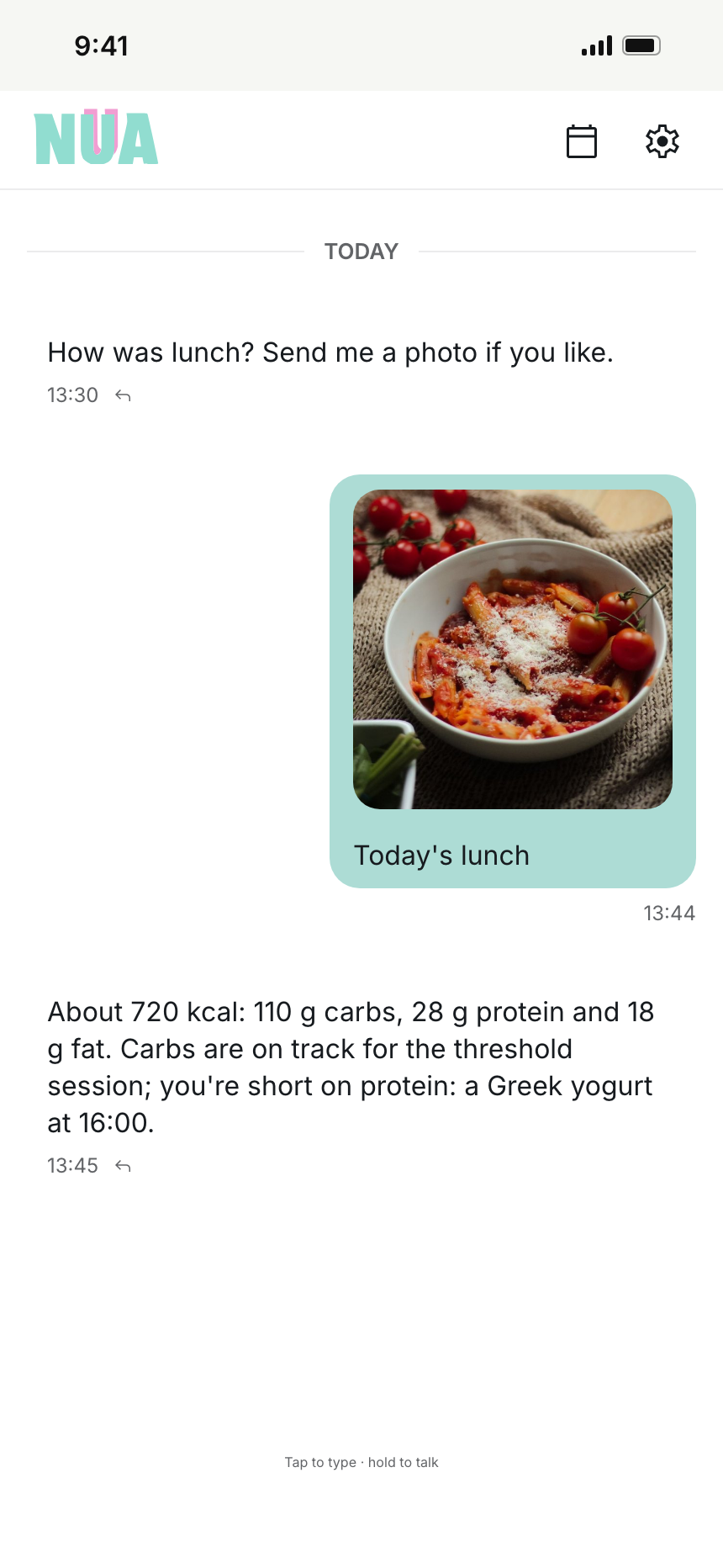

No weighing, no searching a food database. And because NUA remembers what you eat and how you train, over the weeks it spots patterns: whether you're always short on protein or start Saturday rides empty.
How many calories and macros you need for your training: NUA's energy expenditure engine
The plate photo tells you what you've eaten. The energy expenditure engine tells you what you should be eating. NUA calculates your calories and macros (carbs, protein and fat) for each day from three things:
- The energy you burned in completed sessions. NUA reads the activities from your watch or bike computer. A long ride with climbs doesn't burn the same as a recovery spin.
- The energy you'll burn in scheduled sessions. Because NUA also runs your plan, it knows what's coming today, tomorrow and for the rest of the week, so it fuels you before training, not just after.
- Your goal. With the same training, someone trying to lose weight doesn't eat like someone preparing for a race.
Depending on your goal, the plan changes:
- Lose weight: moderate deficit on rest and Z2 days, high protein and enough carbs for intervals and long rides.
- Gain weight: controlled surplus, with more carbs and protein spread through the day.
- Perform: you eat what you burn, with carbs placed around the hard sessions.
- Taper week: volume drops and so does what you burn: it adjusts calories so you arrive fresh without gaining weight or running short on carbs.
- Carb-loading before an event: raises carbs in the days before and tells you what to eat to start with full glycogen stores.
Every day you have your calorie and macro target, and every plate photo tells you how far along you are and what's missing. If the plan changes because you move a session or skip a ride, the numbers change with it. That's how NUA can tell you things like "Tomorrow is the long ride with climbs: add more carbs at dinner tonight" or "Rest day in a taper week: you don't need that much rice".
Food and training in one place
Most cyclists use two or three apps: one for the plan, one for calories and one for routes. None of them talk to each other.
With NUA it's one conversation:
- Morning: "Intervals today. Oats and a banana for breakfast, pasta at lunch."
- Lunch: you send the photo. "About 720 kcal. Good on carbs; a bit short on protein."
- Before riding: "You're heading out in 20 minutes. Take a gel for the second half."
- After: "Good session. Carbs and protein at dinner to recover."
Losing weight with cycling
If your goal is to lose weight:
- Aim for a moderate deficit, not an aggressive one.
- Put it on rest and Z2 days, not interval days.
- Keep protein high so you don't lose muscle.
- Eat on long rides. Saving there doesn't slim you down: it makes you perform worse and eat more later.
NUA adjusts your food to your training every day so you lose weight without running empty in the key session.
Start today
NUA is the AI cycling app that trains with you and prepares your food and your routes. Your personal AI agent.
Start in a minute on WhatsApp, nothing to download. When you want more, there's the app on Google Play (iOS coming soon). Free trial, no commitment; the price depends on your country (see pricing).
Further reading
Shall we try with your next meal? Write to me here:
Sending opens WhatsApp with your message and we carry on there.

Frequently Asked Questions
How does NUA calculate the calories and macros I need?
With its energy expenditure engine. NUA adds up the energy you burned in the sessions you've already done and the energy you'll burn in the ones you have scheduled, and adjusts it to your goal: lose weight, gain weight, perform, a taper week or carb-loading before an event. That gives you your daily calories and your grams of carbs, protein and fat, and the plate photo shows you where you stand.
Does NUA adjust my food during a taper week or for carb-loading before a race?
Yes. During a taper your volume drops and so does what you burn, so NUA adjusts your calories so you arrive fresh without gaining weight or running short on carbs. In the days before the event it raises your carbs for the load and tells you what to eat to start with full glycogen stores.
Is there an app that counts calories from a photo and adjusts to my training?
Yes. In NUA you take a photo of your plate and it estimates calories and macros. Because it's also your coach, it matches them to what you trained today and what's coming tomorrow, and tells you what's missing or what's too much.
How many carbs per hour should I take on the bike?
As a general guide: under an hour you usually don't need any; from 1 to 2.5 hours, about 30 to 60 g per hour; on longer or harder rides, 60 to 90 g per hour, ideally mixing glucose and fructose. You need to train your gut to reach the higher numbers.
Can I lose weight cycling without losing performance?
Yes, if the deficit is moderate and you place it on easy days. Cutting on interval days or before a long ride leaves you empty. NUA adjusts your food to each session so you lose weight without running out of energy in the key workout.
What should I eat before a ride?
2 to 3 hours before, a meal with easy carbs (rice, pasta, bread, oats), some protein and little fat and fibre. If you ride in less than an hour, something small like a banana or toast with honey.
Is the photo estimate accurate?
It's an estimate, not a scale. For a cyclist's day to day it's enough to know whether you're short or over on carbs or protein. If you want more precision, tell NUA the quantities and it will use them.