Strava MCP + Claude: AI Can Now Read Your Training. Can It Coach You?
On June 1st, 2026, Strava launched something we'd been waiting for: an official connector that lets Claude, Anthropic's AI, read your training history and answer any question about it. It's called the MCP Connector, it's available to Strava subscribers, and it has set social media on fire: years of data analyzed in seconds, custom charts, instant conclusions that used to take hours.
We've tested it thoroughly. And the short answer is: the analysis is spectacular. And it's still not a coach.
Let us explain:
What the Strava MCP Connector is (and what it does really well)
Connecting Strava to Claude is simple: you authorize the connection once from Claude's connectors directory and, from then on, the AI can read your activities (heart rate, power, pace, GPS) and work with them in a normal conversation.
You ask things like:
- "Are my easy days actually easy?"
- "What kind of training has improved my fitness the most this year?"
- "Compare this month's climbs with last year's."
And it answers with real data, charts included. No CSV exports, no copy-pasting .fit files, no fighting with filters. For exploring your history and your data, it's probably the best tool an amateur athlete has ever had.
Two important details: access is read-only (Claude can't create or modify anything in your account) and you need a paid Strava subscription.
So far, all genuinely good. The interesting question is a different one.
Analyzing is not coaching: what an AI chat won't do for you
Analysis answers questions about the past. Coaching means deciding the future: what you do tomorrow, with the fatigue you're carrying, the schedule you have and the goal you're chasing. And there, by design, the connector doesn't reach. Three gaps explain it:
Nobody makes the first move. Claude waits for your prompt. It won't text you on Monday with your week planned, or after a hard session to tell you how it went, or any day to move your long ride because your week got complicated or you slept badly. If you don't start the conversation, nothing happens. Ever.
A chat summary is not your fitness state. Claude has memory, but it's memory of conversations: a summary of what you've talked about. It doesn't maintain your training loads, or a living periodized plan, and it doesn't recalculate anything when you finish a ride. Every analysis re-downloads data and redoes the math from scratch, and it's worth noting that language models (Claude included) still get chained calculations wrong, so you have to double-check.
There is no method. Every answer is generated fresh and can follow a different training logic: today it reasons in polarized terms, tomorrow sweet spot; today it looks at your accumulated load, tomorrow it doesn't even check it. And like any general-purpose AI, it tends to agree with you: ask for more volume and you'll get it. Training well demands the opposite: that every decision (training, nutrition, rest…) stays coherent with the others, and that someone holds you back when it's time.
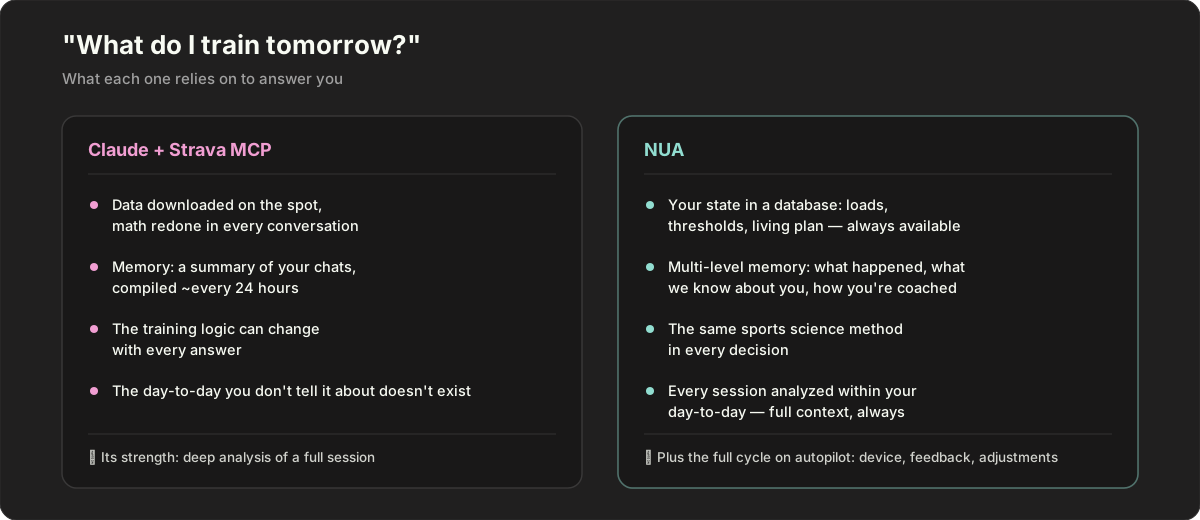
The current reality is that, to get a good training experience, you have to build your own system on top of Claude: a database, different types of memory, a messaging bot so it can be proactive… It works well, but it requires a real investment in programming hours.
Claude + Strava MCP vs NUA: quick comparison
| Claude + Strava MCP | NUA | |
|---|---|---|
| What it is | An on-demand analyst of your data | A coach that runs your day-to-day |
| History analysis | Excellent, conversational | Automatic after every session, and on demand for any past activity, in as much detail as you want |
| Training plan | Writes it as text | Creates it, maintains it, pushes it to your devices and adapts it in real time |
| Proactivity | None: you always start | It writes to you daily: week, feedback, real-time adjustments |
| Memory | Conversation summary | Full state: loads, history, preferences |
| Method | Can change with every answer | The same sports science engine, always |
| Devices | Read-only from Strava | Garmin, Wahoo, COROS, Polar, Hammerhead, Intervals.icu, Zwift, WHOOP (both ways) |
| Effort required from you | You ask, you validate, you execute | Zero: conversational, in the NUA app or on WhatsApp/Telegram |
| Price | Strava subscription (+ paid Claude for heavy use) | Free trial; price depends on your country (see pricing) |
The missing layer: what it takes for AI to coach you
Turning raw intelligence and data into a coach: that's exactly what NUA is. The same power of the best AI models, but with what a real coach needs:
One method, always the same. Every decision goes through a sports science engine: training zones per discipline, thresholds like your FTP auto-detected from your activities, load and fatigue models, physiological limits that are not negotiable. NUA doesn't improvise a new logic with every answer. It applies the same method today, tomorrow and three months from now. The analyst answers you; the coach takes responsibility.
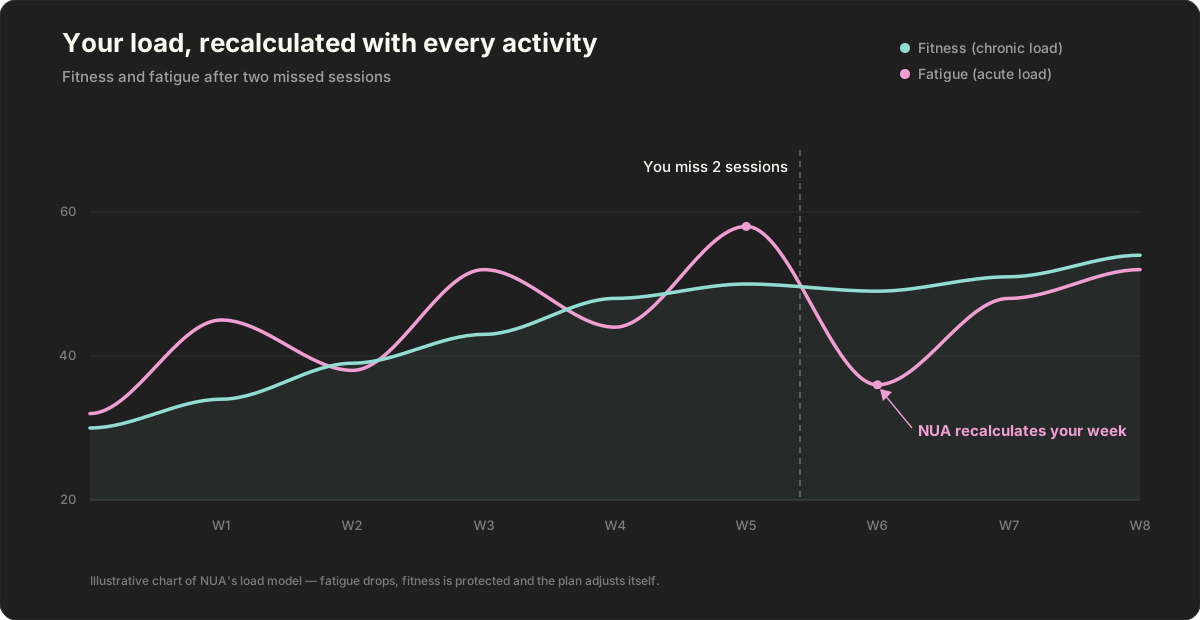
Real memory. Not a chat summary: what has happened (every session, every decision), what we know about you (injuries, preferences, life context) and how you're best coached (what works, what doesn't, how you like to be talked to). Months and years of relationship, not a loose conversation.
Proactivity. NUA writes first: every morning to check how you are and how you've recovered after sleep, when you finish a session, before a race, on Sunday to review the week and plan the next one together, and adjustments whenever it detects accumulated fatigue or a week that doesn't add up. The days you least feel like chasing an AI are exactly the days it matters most that your coach shows up.
Zero friction. Everything happens in NUA's own conversational app (Android available now; iOS very soon) or on WhatsApp or Telegram, in plain language, with no prompts or setup. Your devices are already connected (Garmin, Wahoo, COROS, Polar, Hammerhead, Intervals.icu, Zwift, WHOOP), so workouts arrive on their own and activities come back on their own.
Every new feature is born with your full context
Here's the deep difference between a product and a chat: at NUA, everything we add operates on the same complete athlete context and under the same method.
Nutrition already works this way: today's advice knows what session you have tomorrow and what load you're carrying this week, even the kilojoules you've burned and the ones it estimates you will. Daily sleep and stress data, or the weather for your Saturday ride, come in through the same door: they're not standalone features, they're more information for the same decisions, made with the same criteria. Each new piece multiplies the previous ones.
Behind it there's a team improving it every week and a community of more than 1,100 cyclists in our Telegram group alone. And that's far from all the athletes training with NUA.
Why doesn't Strava do this directly? Because reading data is cheap and coaching someone every day is expensive: AI per active user costs real money, and that doesn't fit the model of a free logging app. That's why the connector is read-only. The coaching layer is an entire product (our full thesis is published here) and it's the one we've been building for more than two years.
Claude or NUA? Both
If you love diving into your data, connect Strava to Claude: for open questions about your history it's great.
But to train (a plan that lives, recalculates with every activity and accompanies you without you having to drag it along), you need the product layer on top of the intelligence. That's NUA: your training decided with method, in the app or on your WhatsApp, every day.
Try it free, no card required. Connect your device, tell it your goal, and let NUA be the one who writes to you.
Want an agent that does this and much more for you? Write to me here:
Sending opens WhatsApp with your message and we carry on there.
Frequently Asked Questions
How do I connect Strava to Claude?
From Claude (web or desktop app), add the Strava connector in the connectors directory and authorize access with your Strava account. You need a paid Strava subscription. From that moment you can ask Claude questions about your activities in natural language.
What is the Strava MCP Connector?
It's the official integration Strava launched on June 1st, 2026. It lets Claude (Anthropic's AI) read your Strava data (activities, heart rate, power, GPS) and answer questions about your training. It's read-only and you can revoke access anytime from your Strava settings.
Is the Strava connector for Claude free?
You need a paid Strava subscription. On the Claude side it works even on the free plan, although with usage limits; if you use it daily you'll probably end up needing a paid plan.
Can Claude create workouts and send them to my device?
No. The connector is read-only: Claude can analyze your data, but it can't create workouts, modify your calendar or push anything to your device. It can write you a plan as text, but keeping it up to date (recalculating it when you miss a day, adjusting load week after week) is on you.
How is NUA different from using Claude with Strava?
Claude answers when you ask; NUA takes responsibility for your training. NUA maintains a living plan that recalculates with every activity, writes to you proactively (week activated, feedback after every session), always applies the same sports science method and remembers your history for months and years. And you use it in its conversational app (Android; iOS very soon) or on WhatsApp or Telegram, with no prompts or setup.
Does NUA connect to Strava?
No. NUA connects directly to your devices and platforms: Garmin, Wahoo, COROS, Polar, Hammerhead, Intervals.icu, Zwift and WHOOP. Your activities arrive on their own, feedback lands within seconds and your plan adjusts automatically.
Can I try NUA for free?
Yes. NUA offers a free trial, no credit card required. Start in a minute on WhatsApp, no download needed; when you want more, there's the app.