NUA now takes your period into account when you train, without calculating your cycle
Gerard
Co-founder
Training on your period is one of those things people talk about very little and decide about a lot: it changes how you arrive at a session, it changes from one month to the next, and it changes from one person to another.
If two women get their period on the same day, NUA doesn't assume they need the same adjustment to their plan. The question isn't which phase of your cycle you're in. It's how you are.
01It adapts to how you are today, not to a calculated phase
Plenty of apps try to adapt training to the phase of your menstrual cycle. They work out whether you're in the follicular, ovulatory or luteal phase and change the plan based on that estimate.
NUA doesn't work that way.
The reason is simple: there isn't enough evidence today to recommend training differently depending on the phase of your cycle. The largest review published to date — 78 studies and close to 1,200 women — found no clear effect on performance, and its own authors avoided making phase-based recommendations.
Then in 2026 came one of the best-designed studies on the question. It was done with strength training in the gym, where each leg can be trained separately: every participant trained one leg with the work concentrated in the follicular phase and the other in the luteal phase, across three consecutive cycles. That removed the differences between people — genetics, sleep, nutrition, stress — and made each woman her own control group.
The result was clear: neither approach produced better results. What explained the gains was total training volume, not the phase of the cycle.
There's also a practical problem. Without confirming ovulation with specific tests, the day of your cycle only allows for an estimate: it doesn't tell you with any certainty which phase you're in.
That's why NUA doesn't calculate phases, doesn't predict ovulation and doesn't adapt training to a calendar. It takes into account how you are, when you tell it.
If you want to understand the full evidence, we go through it in detail in our guide on training with your period and menstrual cycle.
02You don't have to explain it all over again every month
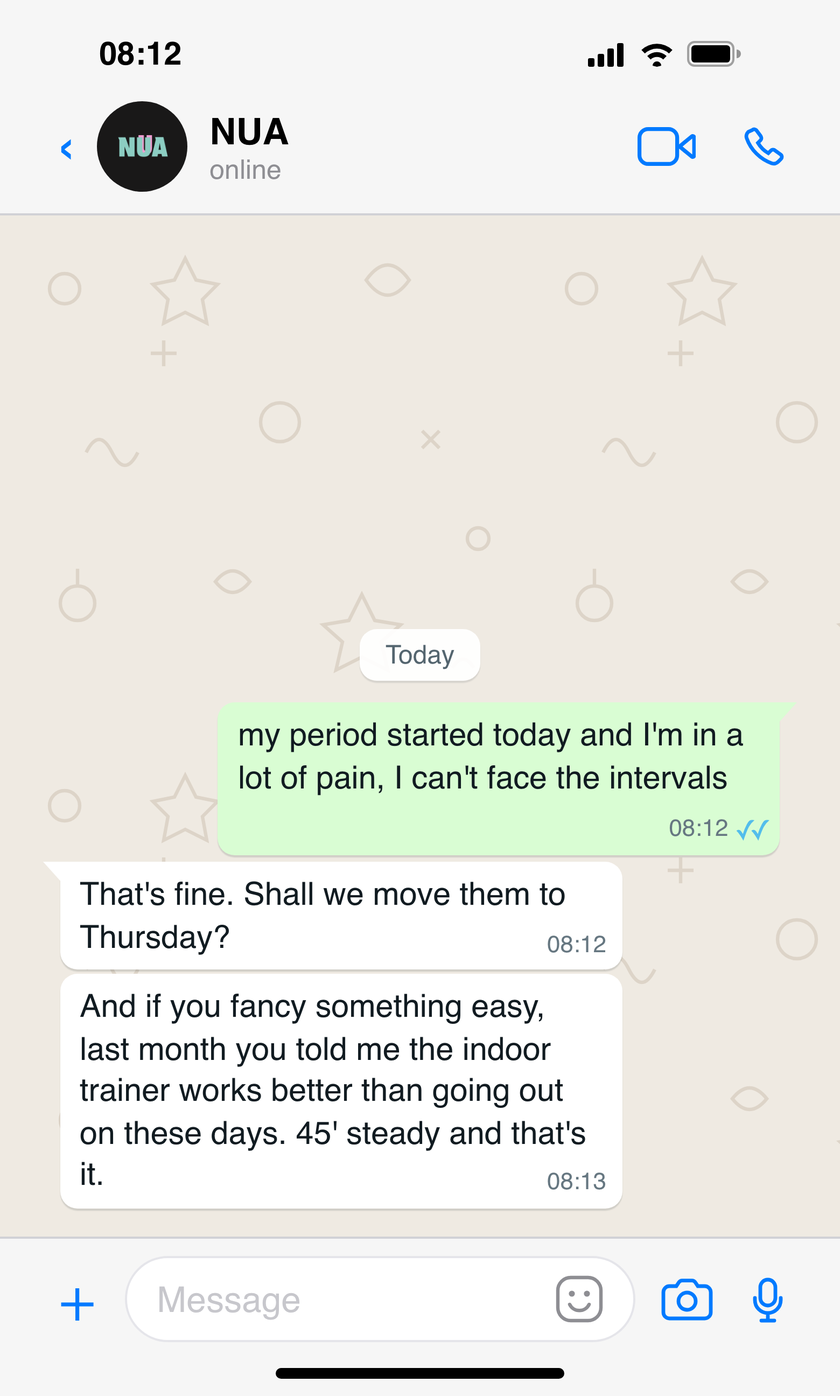
The hardest part usually isn't training on your period. It's having to explain the same thing every month.
If one day you tell NUA that for the first two days the pain means you can barely train, or that you'd rather do the indoor trainer at home than head out, you won't have to repeat it the following month.
And it doesn't stop at remembering. When it plans your week, it leaves that alternative ready in case you need it. Not because it has worked out that "your period is due", but because you'd already told it how you prefer to train when it happens.
When the moment comes, it offers you the option that fits you. The decision is still yours.
And if you'd rather it stopped taking it into account, you only have to say so.
03Common doesn't mean you have to put up with it
Period pain is common, including among women who train.
The problem is that being common ends up turning into "it's normal, put up with it". And those aren't the same thing: the fact that many women are in pain doesn't mean you have to simply live with it. In fact, that normalising is why some conditions take years to be diagnosed.
If NUA sees something worth raising with a doctor, it will tell you once, without alarm.
And that's where its job ends. NUA doesn't try to diagnose, doesn't recommend treatments and doesn't weigh in on contraception: that conversation belongs to a gynaecologist, not to whoever coaches you. From there, whether you go is your call.
NUA doesn't raise the subject
For NUA, this is the most important part.
NUA never starts this conversation. It doesn't ask about your period during onboarding, it doesn't send reminders and it doesn't try to calculate your cycle. It only talks about it if you decide to.
If you never mention your period, NUA never will.
And if one day you want it taken into account when adapting your training, all you have to do is write to it on WhatsApp, the same way you would with anything else that affects how you train.
We're still building your most personal coach
This feature is one more step towards that goal: building a coach capable of understanding each person as they are. A coach that doesn't make decisions based on general profiles, but on the most recent scientific evidence and on the real context of the person in front of it.
That means continuing to improve how it understands the physiological differences between people — including those specific to women and men, where the science shows they matter — and turning that knowledge into training that's more personal, more useful and more human.
Because the goal has never been for NUA to adapt people to a plan. It's exactly the opposite: for the plan to adapt to each person.
Whatever NUA knows about you, you'll have told it yourself.
Ready to train better?
Your personal coach for training, nutrition, recovery and motivation.
Talk to NUAVia WhatsApp · Free 14-day trial