Quebrantahuesos
Distance
200km
Elevation
3500m
The Quebrantahuesos is one of Europe's most iconic cycling gran fondos: ~200 km and ~3,500 m of climbing. Starting and finishing in Sabiñánigo, it crosses the Pyrénées through classic passes like Somport, Marie Blanque, Portalet and Hoz de Jaca. Training should focus on long climbs, simulating long stages and getting used to chaining demanding passes one after another. Over 200 cyclists trained for QH 25 with NUA.
Official site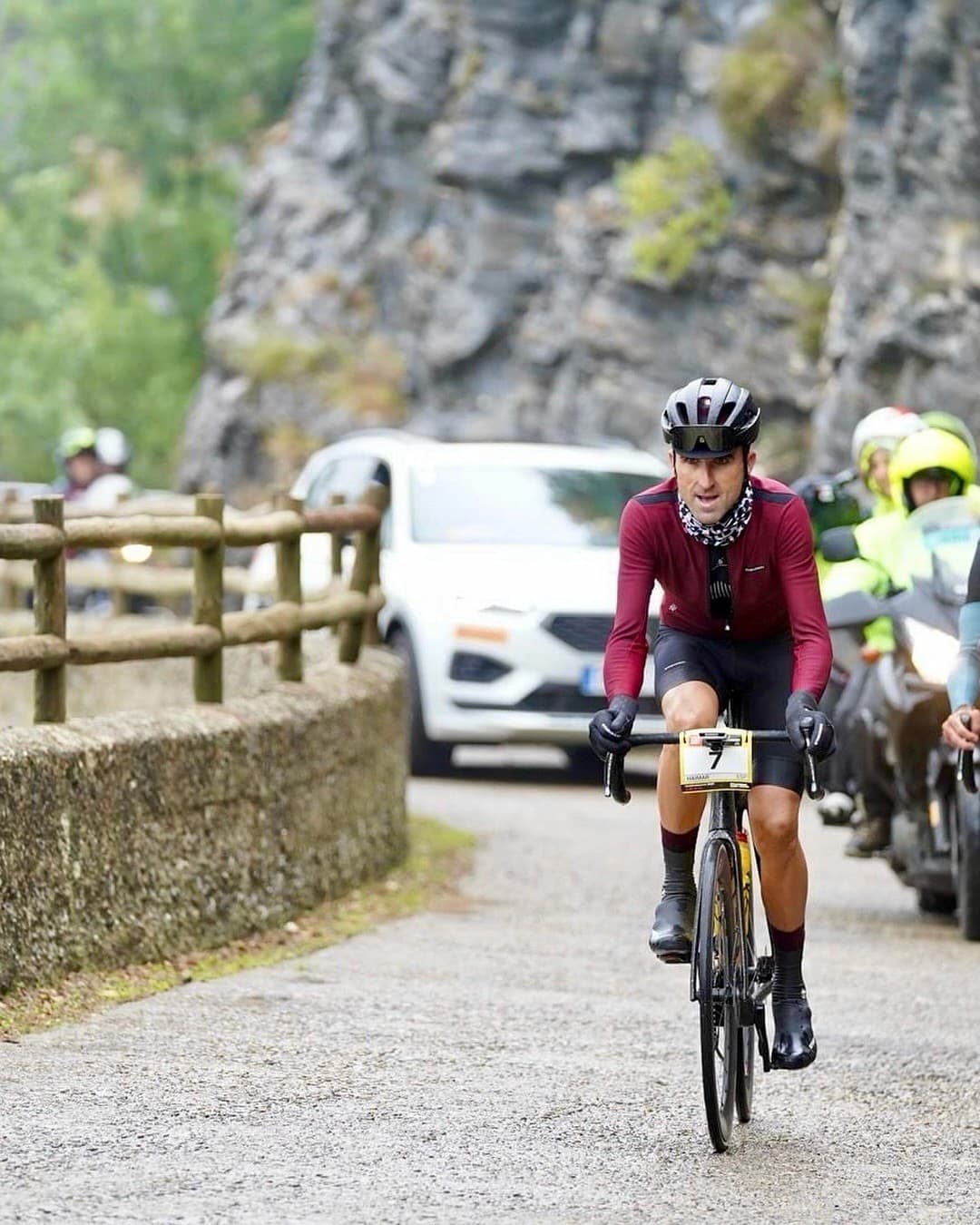
NUA's plan for Quebrantahuesos
NUA's plan for Quebrantahuesos works backwards from race day. We mix aerobic volume (long Z2) with chained-climb blocks that replicate the real fatigue pattern you hit attacking Portalet with Somport and Marie Blanque already in your legs. NUA auto-detects your FTP from your rides, adjusts the targets every week and prescribes the final taper automatically — over 200 cyclists trained for QH 25 this way.
The Quebrantahuesos at a glance
The Quebrantahuesos is a gran fondo of about 200 km and about 3,500 m of climbing that starts and finishes in Sabiñánigo (Huesca), crosses into France and comes back through the Pyrenees. It is not a day with one brutal climb but one of long climbs back to back: what decides how you reach the finish is how much you have spent before the Portalet and whether you have eaten well from the start.
| Section | What you will find | Key |
|---|---|---|
| Sabiñánigo to Jaca | Group start, fast and nervous | Do not burn matches; find a group at your pace |
| Somport | Long, gentle climb that gets harder at the end, up to the border | Comfortable pace and start eating early |
| Descent into France | Long descent through the Aspe valley | Wrap up at the top; drink at the bottom |
| Marie Blanque | Short climb with very hard final kilometres | Low gear and stay below threshold |
| Portalet | The longest climb of the day, almost 30 km from Laruns | Sustainable pace and eat at the bottom |
| Hoz de Jaca | Short climb that comes with many kilometres in your legs | Whatever is left, without digging too deep |
| Biescas to Sabiñánigo | Final stretch through the valley, often windy | Ride in a group and keep drinking |
How much time you need: 20-24 weeks in 4 phases
If you ride regularly, 20 to 24 weeks is enough to arrive in shape. The sample weeks below are a guide for an amateur with 6 to 10 hours a week; zones refer to your FTP (Z2 = aerobic endurance, sweet spot = 88-93 % of FTP, threshold = 95-105 %). If you have less time, start at phase 2. If you do not know your zones, you can work them out with the power zones calculator.
Phase 1. Aerobic base (weeks 1-8)
Goal: build the aerobic engine, get your body used to spending hours on the bike and start strength work in the gym. Almost all the volume in Z2, some tempo and a long ride that grows each week up to 4 hours.
| Day | Session |
|---|---|
| Monday | Rest |
| Tuesday | 1 h 15 min in Z2 with 4 × 1 min high cadence |
| Wednesday | Gym strength, 45 min (squat, Romanian deadlift, lunges, core) |
| Thursday | 1 h 30 min with 3 × 10 min tempo (Z3) |
| Friday | Rest or 45 min very easy |
| Saturday | Long ride of 3 to 4 h in Z2 over rolling terrain |
| Sunday | 2 h in Z2 |
Phase 2. Build and climbing strength (weeks 9-15)
Goal: raise your threshold and learn to hold long efforts on climbs. Sweet spot blocks and the first long climbs at a controlled pace appear. Strength moves to maintenance.
| Day | Session |
|---|---|
| Monday | Rest |
| Tuesday | 1 h 30 min with 4 × 8 min sweet spot |
| Wednesday | Maintenance strength, 30 min, and 45 min easy spin |
| Thursday | 1 h 30 min with 5 × 6 min climbing at low cadence (65-75 rpm) in upper Z3 |
| Friday | Rest |
| Saturday | 4 to 5 h with 2 or 3 long climbs in Z3 |
| Sunday | 2 h in Z2 |
Every third or fourth week, cut volume by 30-40 % to absorb the load.
Phase 3. Quebrantahuesos-specific (weeks 16-21)
Goal: rehearse the race. Long rides with chained climbs, eating as on race day and handling two loaded days in a row. It is the hardest block and where the Quebrantahuesos is won.
| Day | Session |
|---|---|
| Monday | Rest |
| Tuesday | 1 h 30 min with 3 × 15 min sweet spot |
| Wednesday | 1 h in Z2 and 20 min maintenance strength |
| Thursday | 1 h 15 min with 5 × 4 min in Z5 (VO2 max), 4 min recovery |
| Friday | Rest |
| Saturday | Simulation: 5 to 6 h with 2,500-3,500 m of climbing chaining climbs, eating 60-90 g of carbs per hour |
| Sunday | 2 to 3 h in Z2 on tired legs |
Do two or three simulations in this block, separated by at least one easier week.
Phase 4. Taper (weeks 22-24)
Goal: arrive fresh without losing fitness. Volume drops by 40 to 60 %, but short efforts at race pace stay in so your legs do not switch off.
| Day | Session (race week) |
|---|---|
| Monday | Rest |
| Tuesday | 1 h with 3 × 5 min at climbing pace |
| Wednesday | 45 min easy |
| Thursday | 1 h with 3 × 1 min hard |
| Friday | Rest, travel and bib pick-up |
| Saturday | Quebrantahuesos |
| Sunday | Recovery |
Climb by climb: how to pace each ascent
Somport. The first big climb is long and gentle, and it gets harder in the final kilometres up to the border. The most common mistake is sitting on the wheel of groups climbing above your pace because your legs feel fresh. Climb in upper Z2 or lower Z3, below what you could hold, and start eating from the bottom: whatever you do not eat here, you will pay for on the Portalet. It can be cold at the top; put your gilet on before the descent.
Marie Blanque. It is short compared with the others, but its final kilometres have sustained ramps above 10 %. Shift into your lowest gear before the gradient forces you to, stay seated as much as you can and accept that you will go slowly. Going over threshold here, still far from the finish, is the fastest way to ruin the rest of the day.
Portalet. It is the longest climb of the ride, almost 30 km from Laruns, with gentle stretches and tougher ones towards the top. You reach it with many kilometres in your legs, and the lower part is often hot. Eat and drink well at the bottom, set a pace you can hold for well over an hour and do not change it because of what others do. If you have strength to spare, save it for the final kilometres.
Hoz de Jaca. After the Portalet descent comes a short climb that feels hard because of the accumulated fatigue. Climb with what you have left, keeping your cadence up and without digging too deep: the valley stretch to Sabiñánigo is still to come.
The finale. From Biescas to Sabiñánigo the terrain is favourable but the wind often blows. Riding in a group saves a lot of energy; keep drinking and eating on this stretch.
Nutrition: 60-90 g of carbs per hour
On a ride this long, food matters as much as your legs.
- The days before. Increase your carbohydrate intake (around 8-10 g per kilo of body weight) in the previous 24-48 h and cut down on fibre.
- Breakfast. About 3 hours before the start, something you have tested and rich in carbs: rice, bread, toast with jam, banana.
- During the race. Between 60 and 90 g of carbs per hour from the first hour, combining sports drink, gels, bars and some solid food early on. Above 60 g/h, glucose and fructose blends work better.
- Fluids and salt. Between 500 and 750 ml per hour depending on the heat, with sodium, especially on the lower part of the Portalet and the final valley stretch.
- Train your gut. Over the previous 6 to 8 weeks, use your long rides to gradually increase the grams per hour and test exactly the products you will carry. Nothing new on race day.
To give you an idea: 8 hours at 70 g/h is 560 g of carbs, roughly 20 gels. Plan what you carry and what you take at the feed stations.
Gearing: 50/34 compact and an 11-32 or 11-34 cassette
For most amateurs, the most sensible setup is a 50/34 compact chainset with an 11-32 or 11-34 cassette. The Marie Blanque is what dictates it: with a 34 × 32 or 34 × 34 you can climb its final ramps seated at a reasonable cadence, without burning the legs you will need on the Portalet. If in doubt, compare ratios with the gearing calculator.
Also check your brake pads and tyres: there are long descents, sometimes on damp tarmac higher up. You can set your pressure with the tyre pressure calculator.
Pyrenees weather in June
The Quebrantahuesos is held in June, and on the same day you can get three climates:
- A cool start early in the morning in Sabiñánigo.
- Cold on the summits and descents, especially if there is fog, wind or rain on the Somport or the Portalet. This is where most people suffer.
- Heat in the afternoon in the valleys and on the lower part of the Portalet.
Carry a windproof gilet and arm warmers even if the forecast is good, and a light rain jacket if storms are possible. Check the forecast for each pass (not just Sabiñánigo) in the days before.
Tapering: the last two weeks
- Two weeks out: last weekend with some volume, without a full simulation.
- Final week: volume at 40-60 % of normal, with 2 or 3 short sessions including efforts at race pace.
- Sleep more, increase your carbs over the last two days and do not try anything new: no new saddle, shoes or gels.
Race-day checklist
- Bike checked: brakes, tyres, gears indexed, low gearing fitted.
- Bib and chip fitted the night before.
- Clothing: jersey, bib shorts, gilet, arm warmers and a light rain jacket if rain is possible.
- Food counted by the hour (gels, bars, solid food) and bottles with electrolytes.
- Repair kit: inner tube, tyre levers, CO2 or pump, multi-tool.
- Bike computer charged, with the route loaded and eating and drinking alerts on.
- Sunscreen, a tested breakfast and arriving at your start pen with time to spare.
How NUA adapts all of this, day by day
A PDF plan does not know you slept badly this week, that it will rain on Saturday or that you are travelling on Wednesday. NUA is your personal AI agent and works across everything at once:
- Training. It builds the plan backwards from Quebrantahuesos day and adjusts it every day to your sleep, your HRV, how you feel and your schedule. It detects your FTP from your rides and sends sessions to your Garmin, Wahoo, COROS, Polar or Intervals.icu. Strength sessions with videos are included.
- Routes. It plans your simulation route with chained climbs near you, taking into account the weather and the session you need to do.
- Food. From a photo of your plate it estimates calories and macros, and tells you what to eat before the long ride or during carb loading.
- Reminders. It reminds you about carb loading, checking your bike or testing your race nutrition on the next simulation.
- Proactive alerts. If rain is forecast for Saturday or your recovery is low, it messages you before you ask and suggests moving the session.
Start in a minute on WhatsApp, no download needed. When you want more, there's the NUA app (Android on Google Play; iOS coming soon). From €12.50/month, with a free trial.
Frequently asked questions about training for Quebrantahuesos
Hoeveel sporters heeft NUA voorbereid op Quebrantahuesos?+
How many weeks do I need to prepare for the Quebrantahuesos?+
How many hours a week should I train for the Quebrantahuesos?+
What gearing should I use for the Quebrantahuesos?+
How much should I eat during the Quebrantahuesos?+
What is the weather like at the Quebrantahuesos?+
How does NUA help me prepare for the Quebrantahuesos?+
Bereiden we Quebrantahuesos voor? Schrijf me en we beginnen:
Bij verzenden opent WhatsApp met je bericht en gaan we daar verder.